Why Financial Services Is the Highest-Stakes Frontier for Agentic AI
- Aphelion Labs
- Financial services , Agentic ai
- April 28, 2025
Table of Contents
Financial institutions have been promised AI transformation before. The reality has usually been more modest: a fraud detection model here, a chatbot that handles simple FAQs there. Useful, but nowhere near the step change that was advertised.
Agentic AI is different — and the difference matters most in financial services.
What makes agentic AI distinct
Most AI deployments to date have been reactive and narrow. A model receives an input, produces an output, and stops. A human takes that output and decides what to do next.
Agentic systems operate differently. They pursue goals across multiple steps, call tools, query systems, make decisions, and take actions — with human oversight built in at the right checkpoints rather than at every single step.
In a financial services context, that distinction is the difference between:
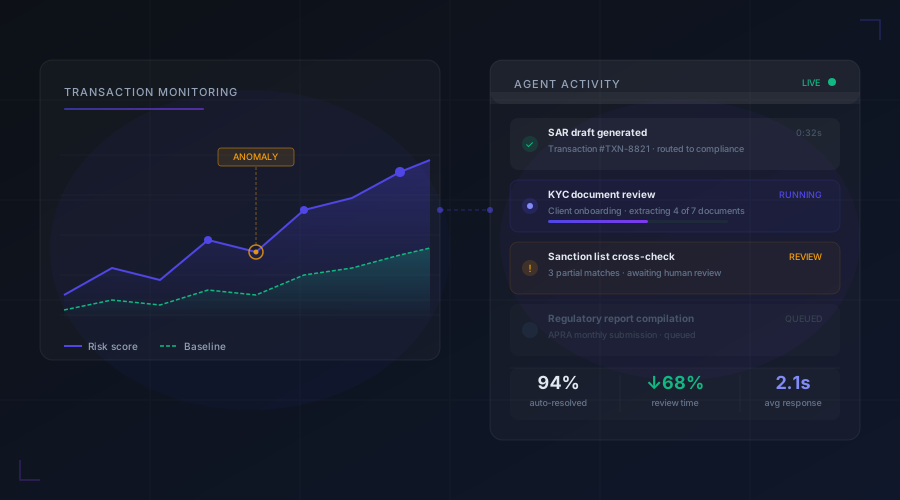
- A model that flags a suspicious transaction, and an agent that investigates it — pulling counterparty history, cross-referencing sanction lists, drafting a SAR, and routing it to the right analyst
- A system that summarises a client portfolio, and one that monitors it continuously, identifies drift from mandate, and generates a compliant rebalancing proposal
- A tool that answers compliance questions, and one that tracks regulatory change, assesses impact across the business, and updates internal policy documentation
The operational case
Financial institutions carry enormous operational overhead. Back-office processes — KYC, AML monitoring, document processing, reconciliation, reporting — are typically labour-intensive, error-prone, and slow.
These are precisely the processes where agentic AI delivers the clearest near-term ROI:
- KYC & onboarding — agents that gather, verify, and assess customer data across sources, reducing onboarding time from days to hours
- Document intelligence — extraction, classification, and routing of unstructured documents (contracts, statements, filings) at scale
- Compliance monitoring — continuous surveillance of communications, transactions, and positions against evolving regulatory thresholds
- Reporting automation — agents that pull from multiple systems, reconcile figures, and produce board-ready output without manual assembly
The risks that make getting it right non-negotiable
The same characteristics that make financial services a compelling target for agentic AI also make it the domain where failure carries the highest cost.
Regulatory exposure is real. An agent operating without adequate audit trails, explainability, or human escalation paths creates liability that no institution can absorb. Data governance matters — agents interact with sensitive customer and market data, and the architecture must enforce access controls and data residency requirements from day one.
This is not an argument for moving slowly. It is an argument for building correctly.
What a production-ready agentic system looks like
In our engagements with financial institutions, the systems that reach production and stay there share a few characteristics:
- Defined scope with clear escalation paths — agents are given specific mandates with explicit triggers for human review, not open-ended autonomy
- Audit by design — every action, tool call, and decision is logged in a format that satisfies regulatory requirements
- Integration-first architecture — agents are built around the data and systems the institution already operates, not a parallel data stack
- Incremental deployment — pilot on a contained use case, prove the economics, then expand — rather than attempting enterprise-wide transformation in one programme
The window is now
The institutions moving fastest on agentic AI today are not doing so because they have more resources. They are doing so because they have made a strategic decision to treat AI transformation as a core competency rather than a technology project.
The gap between early movers and late adopters will compound quickly. The underlying models are improving faster than most organisations can absorb. The institutions that build the operational muscle now — the architecture, the governance frameworks, the internal capability — will have a durable advantage over those who wait for the technology to “mature.”
It is mature enough. The question is whether the organisation is ready to meet it.
Aphelion Labs works with financial institutions to design, build, and deploy production-ready agentic AI systems. If you’re exploring where to start, get in touch.